Ten Commandments of Relocating Overseas #4: Develop tolerance for ambiguity and frustration

Develop tolerance for ambiguity and frustration by being flexible and open toward the new culture.

Effects of Culture Shock

• A sense of uprootedness
• Feeling of disorientation
• Not knowing what is going on
• Behaviors and attitudes which were necessary for obtaining goals in the culture we learned are no longer useful
• Familiar behaviors which marked a well-adjusted person in one’s own culture are now seen as bad manners
• So many adjustments to be made that one becomes overwhelmed, frustrated, and angry

All these things can lead to you not being the most open-minded toward your host culture and country.  Do we need to go through certain steps until we get to the tolerance that we seek?

Typical Pattern of Culture Shock

1. At first we think it is charming
2. Then we think it is evil
3. Then we think it is different

Almost everyone who studies, lives or works abroad experiences some degree of culture shock. This period of cultural adjustment involves everything from getting used to the food and language to learning how to use the telephone. No matter how patient and flexible you are, adjusting to a new culture can, at times, be difficult and frustrating. It is easy to get lost, depressed and homesick. You may even want to go back home!

Don’t panic…these are all totally normal reactions and you are not alone. Sometimes it is hard to remember why you decided to leave home. You are on an adventure – a wonderful opportunity to grow and learn – but it does not always seem that way.  Staring you straight in the eye, you cannot avoid culture shock entirely.

Adjusting to a new culture can be difficult and frustrating, but it can also be a wonderful, thought-provoking time of your life during which you will grow as a person. Living in a foreign country will open new doors, introduce you to new ways of thinking, and give you the opportunity to make life-long friends. The most effective way to combat culture shock is to step back from a given event that has bothered you, assess it, and search for an appropriate explanation and response. Try the following:

• Observe how others are acting in the same situation
• Describe the situation, what it means to you, and your response to it
• Ask a local resident or someone with extensive experience how they would have handled the situation
and what it means in the host culture
• Plan how you might act in this or similar situations in the future
• Test the new behavior and evaluate how well it works
• Decide how you can apply what you have learned the next time you find yourself in a similar situation

Throughout the period of cultural adaptation, take good care of yourself. Read a book or rent a video in your home language, take a short trip if possible, exercise and get plenty of rest, write a letter or telephone home, eat good food, and do things you enjoy with friends. Take special notice of things you enjoy about living in the host culture.

Although it can be disconcerting and a little scary, the “shock” gradually eases as you begin to understand the new culture. It is useful to realize that often the reactions and perceptions of others toward you–and you toward them–are not personal evaluations but are based on a clash of cultural values. The more skilled you become in recognizing how and when cultural values and behaviors are likely to come into conflict, the easier it becomes to make adjustments that can help you avoid serious difficulties.

* Information and excerpts were taken from Julia Ferguson’s website.

This article was submitted by a guest author and ISC member.
Selecting an International School Tip #2: Is the School Conveniently Located?

What reasons do parents think about when selecting a school for their children when they move abroad? Are they similar reasons why teachers choose to work at a school abroad as well?  Many international school teachers are in teaching couples that have children.  There are also international school teachers that are married to a local and have children too.  So, how do you choose the right international school for your children to attend?  This blog series will discuss the Tips for Selecting an International School.

Tip #2: Is the School Conveniently Located?

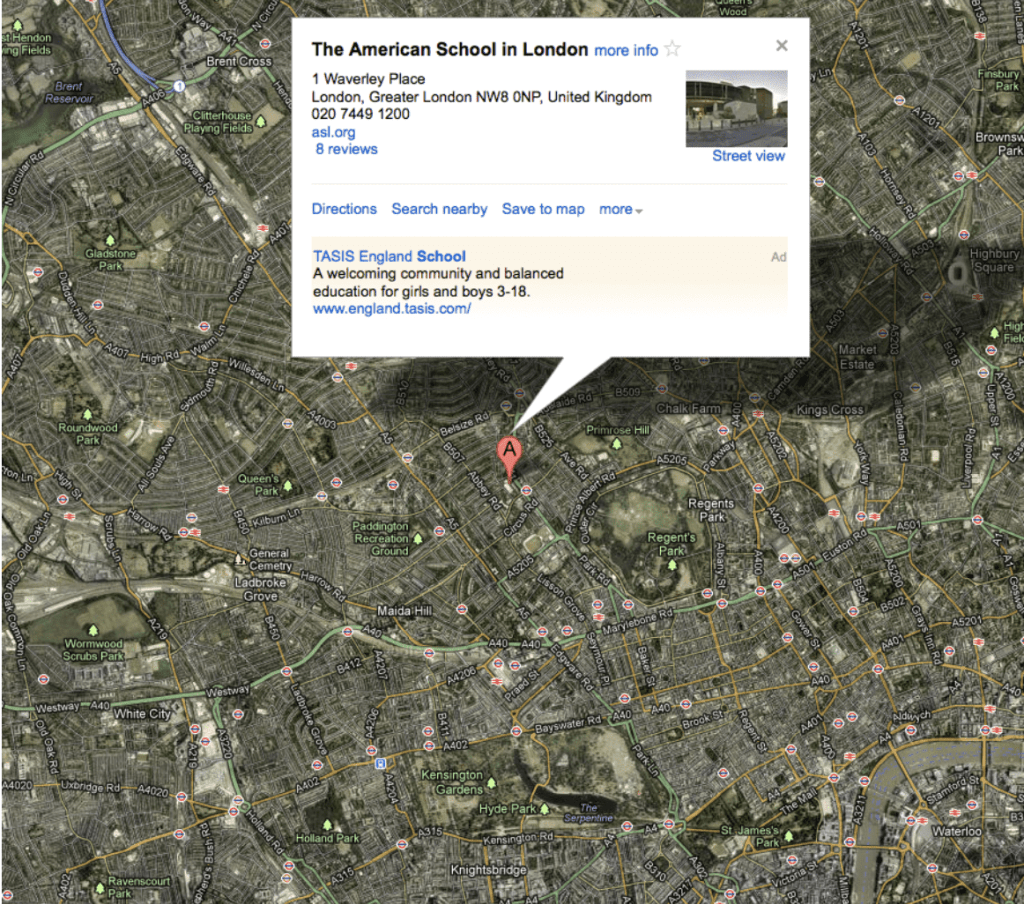
The American School of London (see above picture) and the United Nations International School in New York City are conveniently located, but not all international schools are in the same situation.  Some international schools are built way outside of the city center, far away, especially if you plan on living in the city center.  Sometimes your journey to work might be around one hour, one-way; an important thing to know before you decide on signing a contract to work at an international school.

If you don’t mind living in a 3rd ring suburb, maybe it wouldn’t be such a big of an issue that your school is so far away from the city center.  However, if you like to enjoy city life and prefer to live there as well, then it might not be the best fit to work at an international school that is not centrally located.

If you are a teacher with children that attend the school, living closer to school also might be a positive thing.  Maybe if you have children, you wouldn’t mind working at a school that is way out in the suburbs because that is always where you would prefer to live anyway.

Before signing a contract, an international school teacher definitely needs to evaluate their current situation and what their living-situation needs are.  Make sure to ask the right questions at the interview about how your current situation and needs match with the location of the school and where you would most likely be living in relation to that school.

If you had a choice, what would be the preferred way for you to and from work every day?  Would you rather ride your bike, take a bus, take the school bus, ride on a train, walk, drive your car, take a taxi, or a combination of 2-3 types of transportation?  What amount of time is an acceptable journey length: 10-15 minutes, 15-30 minutes, 45 minutes, or over one hour? The ISC blog has a series called The Journey to School which highlights a number of journeys to schools from around the world. Check it out to get a first-hand account of what the journeys are like.

One colleague friend of mine worked at a school that was more than a one-hour journey from their apartment.  Most of the teachers there were taken to and from the school on one of the school’s buses “for teachers.”  One positive thing this teacher took away from that experience was that many teachers were forced to not work so long at the school.  Because of the fact that the school bus for teachers left at a specific time, you had to get on that bus…otherwise you would be stuck at school with limited options to get home!  Sometimes teachers do need to stay long at school to get work completed, but often teachers don’t really need to stay for hours and hours.  If you are forced to end your workday at a certain time, you would be surprised how much of your work gets done during that time constraint.

Another colleague friend of mine lives in the city center and their school is very conveniently located in relation to the city center.  Many teachers at this school also live where this teacher lives, and the journey from home to school is around 12-15 minutes by train and 20-25 minutes by bike.  Many of the teachers at this school are quite pleased that they at least have the option of living in the city center and also have a relatively easy commute to work.  There are also many options to get to work based on the needs and situation of each teacher.  It is nice when there are many transportation options available to meet the needs of a diverse staff.

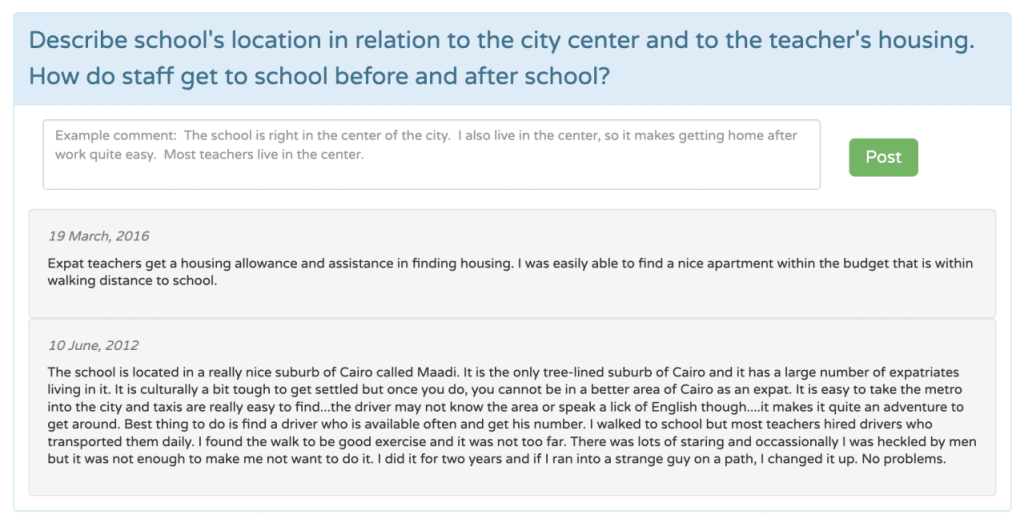
We have had 1710 comments and information (30 October 2022) submitted about this very topic on a number of international schools on International School Community’s website.  For example on the Kaohsiung American School‘s profile page there have been four comments submitted so far:

On the Misr American College school profile page, we have two rather informative comments about the school’s location:

On the American Embassy School New Delhi school profile page, we have useful details about the school’s location:

If you are an international school teacher currently working abroad, please share your comments about if your school is conveniently or NOT conveniently located.

Additionally, make sure to join www.internationalschoolcommunity.com as you are able to check out our over 24000 members.  Many of our current members have listed they work at over 2000 international schools around the world. Feel free to send these members a message with your questions about where most teachers are living in relation to the school and the city center.

ISC’s Job Vacancy Feature Update: Find the Job of your Dreams!

Our Job Vacancies feature (premium membership required) was launched just over two years ago, but its popularity already exceeds all our expectations. With our members submitting these job vacancies, each of their submissions helps another teacher find new and interesting positions at international schools worldwide. Every job vacancy submission helps schools around the globe reach new people who might just be the perfect fit for the position.

We would hereby like to thank the ISC Community for all of their 4900+ submissions (Oct 2022)

Check out this video from our Youtube Channel that highlights our job vacancy page.

Submit the job vacancies you know about today at your international school and earn free premium membership! You get one week of free premium membership for every job vacancy you submit.

Looking at all the submitted job vacancies so far, we would like to share a few statistics that we found.

So far 4916 job vacancies have been submitted in just over three years.

We have designed the job vacancies page to keep all of the submitted job vacancies on one page, even if they have expired.  We wanted our members to see which job positions have shown up for a school over time, and how many times a certain job position has shown up over time as well. For example, maybe if the school has just posted about the job position you are looking for last month, that position probably won’t show up the following month or the following year or two for that matter. Or if the position keeps showing up for a school, one might wonder why they are consistently having that job available each year. The expired job vacancy postings are clearly marked, so it is clear which ones are active or not.

There have been job postings submitted in a number of countries from around the world:

• Singapore
• India
• Indonesia
• China
• Spain
• Japan
• USA
• Hong Kong
• Italy
• UAE
• Turkey
• Uganda
• Thailand
• Malaysia

and many more…

There have also been job postings submitted for a number of school positions:

EAL Teacher: Around 100
Science: Around 380
Maths: Around 400
History: Around 60
Classroom Teacher: Around 140
PE: Around 90
Business Teacher: Around 80
Design Teacher: Around 110
Art Teacher: Around 380
Principal: Around 130

and many more…

We are so glad that we have added this feature to our website. If you have a good story of how our posted job vacancies led to you getting an interview and eventually an offer, let us know by writing to us via our Contact Us page.